New HCI researchers often treat time as the easy variable. Start a timer, let someone complete a task, stop the timer. Yet "how long did it take?" can refer to a system response measured in milliseconds, a decision measured in seconds, a habit formed over months, or a social change that takes years.
Those are not interchangeable measurements. The useful unit depends on the phenomenon you want to study, and the method has to match it.
Four different clocks
Allen Newell's Time Scale of Human Action, introduced in his 1990 book Unified Theories of Cognition, maps human action across layers that run at very different speeds. Neural activity happens in milliseconds. Deliberate reasoning takes seconds. Planning can unfold over hours. The original framework is a spectrum, not a tidy set of boxes.
HCI researchers often discuss four broad bands: biological, cognitive, rational, and social.
Suppose you are studying whether a button responds before a user notices lag. That question sits in the biological band and needs precise timers and controlled conditions. An interview will not tell you what a participant's nervous system registered at 80 milliseconds.
If you are studying whether people can find a settings menu, seconds and minutes become useful. Observation, think-aloud sessions, and task completion time can show where a person hesitates or takes a wrong turn. This is closer to the cognitive band.
If the question is whether people keep a new productivity habit, one session is too short. Diary studies, experience sampling, or longitudinal surveys can follow the behaviour over weeks or months.
To study how technology changes family dinners, the relevant timescale may be years. Ethnography, cultural comparison, and interviews across generations make more sense than a stopwatch.
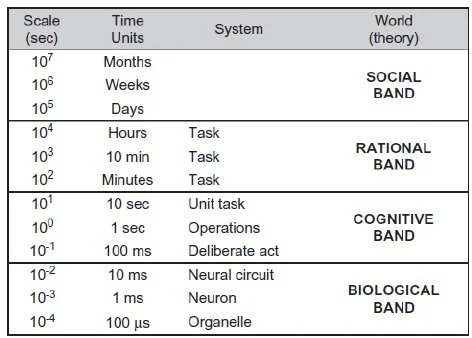
The middle bands fit conveniently into a one-hour study, so beginners often start there. Some HCI questions do not. The fastest effects may happen before conscious awareness, while the slowest emerge across a community or generation.
A dinner table is not a lab task
Think about a household in which dinner once happened at a fixed time around a table. A television later drew the chairs toward one shared screen. Phones then gave each person a separate screen. The family may still be in one room, but their attention is organised differently.
That description is only a possible pattern, not a finding. A researcher would still need to learn whether it happened, in which households, and what family members think changed. The point is that the change cannot be reproduced honestly as a short lab task.
Imagine studying smartphone use during dinner in Bangladeshi urban households. Interviews with grandparents, parents, and teenagers could reveal how each generation remembers the meal. The questions might cover who spoke, what counted as an interruption, and whether sitting together still felt like spending time together.
Screen time could be one measurement, but it would miss much of that experience. A phone on the table may matter even when nobody touches it. A long meal may contain lively conversation or prolonged silence. Duration needs context.
This is social-band research. The method is slow because the question is about change over time.
Clean data can answer the wrong question
A common mistake begins with an important question about how technology is changing behaviour. The researcher then reaches for a familiar method designed for a much shorter timescale. A one-session lab study is used to discuss a change that unfolds over years, or task completion time is used as a substitute for a social habit.
The mistake is understandable. Lab studies are often taught first, and their numbers look reassuringly precise. Precision does not help when the study is aimed at the wrong timescale. A thirty-minute usability session cannot show a generational change in family life.
Method selection should begin with the phenomenon:
- For milliseconds, use precise technical measurement.
- For seconds or minutes, controlled observation may fit.
- For weeks or months, plan repeated or longitudinal measurement.
- For years and social change, consider ethnography and interviews across time or generations.
These are starting points, not fixed rules. A project can also combine methods. A researcher might log phone use during dinner for two weeks, interview family members afterward, and compare accounts across age groups. Each method sees a different part of the question.
Duration needs context
Even within one band, a duration does not explain itself. Four minutes on a checkout page might mean careful attention or complete confusion. Leaving an article after twelve seconds could mean the opening answered the question, or that the reader disliked it.
This is why timing data often needs another measure beside it. Error counts, observation notes, interview responses, or interaction logs can help explain what happened during those seconds.
At the social band, a researcher may care less about one interaction than about how repeated interactions change what feels normal. There may be no single moment when a family habit changes. Retrospective interviews have limits, but they can reveal how people describe that gradual shift.
Begin with the timescale
Before choosing a method, write down the research question and ask: at what timescale does this phenomenon occur?
If the honest answer implies a longer study than you can run, narrow the question. Study one part of the behaviour, shorten the period you claim to explain, or state the limitation clearly. What matters is that the question, measurement, and claim refer to the same slice of time.
No single study can cover every layer. It can, however, be explicit about what it observes and what those observations can support. That is a better use of time than collecting precise measurements for a question that lives somewhere else.